Where should a small business start with local SEO? Start with the facts. Make sure your business name, address or service area, phone number, hours and services are correct everywhere they appear. Then set up an eligible Google Business Profile, publish one useful page for each real service you offer, make it easy to call or enquire, and measure the enquiries you receive. Rankings can change over time, but no one can guarantee them.
Local SEO means making your business easy to find and trust for people who search near them, or for a service in their area. Search and maps look at business details, the website, reviews and other public information to decide what to show. This guide sets out a sensible order of work for a shop, clinic, tutor, service provider or other local business in India.
What local SEO means, in plain words
Ordinary search engine optimisation helps a website appear for a topic. Local SEO adds location and nearness. A customer who searches for a service with a town name expects results from businesses that actually serve that place. Your job is to show, clearly and honestly, what you do and where you do it.
Local results also draw on your Google Business Profile, a free listing that can appear in Google Search and Maps. Your profile and your website support each other, so both need accurate details.
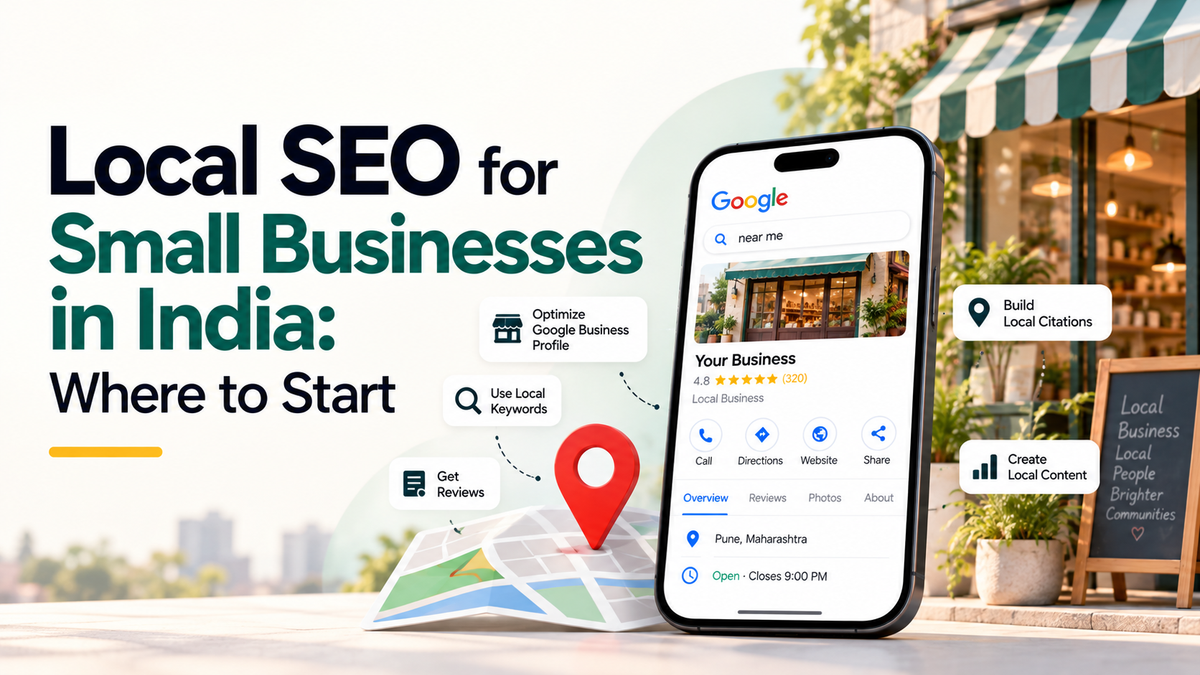
The five basics, in priority order
Work through these in order. Each one makes the next one more useful.
- Accurate business facts. Use the same name, address or service area, phone number, hours and services on your website, your profile and your invoices. Mismatched details confuse customers and search systems alike.
- A Google Business Profile. Set up an eligible profile and complete verification. The Google Business Profile checklist walks through each step. Google controls verification and how profiles appear.
- One useful page for each real service or area you serve. A page should describe the service, who it helps, how it works in general terms, what is included, where you work and how to contact you. One page per real service is a sensible start.
- A clear contact action. Put a phone number, a WhatsApp link or an enquiry form near the top and bottom of each service page. Make it work on a phone, and test it yourself.
- Measure enquiries, not only rankings. Count calls, form messages, WhatsApp chats and walk-in visits. Note where each one came from where you can. A ranking that brings no enquiries is not much use.
Make each page useful, not repeated
Local pages are often copied with only the town name changed. Customers notice this, and it is weak evidence for search systems. Write each page for one service and the people who need it. Add real detail: what you do, what is included, photos of your actual work, and the questions customers ask you most often.
If you truly serve several nearby areas, name them naturally, with real local details such as the roads you cover or the kind of places you visit. Do not list every place in the district.
What not to do
- Do not buy reviews. Paid, gated or invented reviews break Google's rules and damage trust. Ask real customers instead.
- Do not create doorway pages. A doorway page is built only to rank for a city or area you do not serve. Do not publish one page per town from a keyword list.
- Do not promise rankings. No one can guarantee a position on Google or Maps. Be cautious with anyone who promises a fixed result or instant results.
- Do not hide or invent your location. A storefront should show its real address. A service-area business should use the service-area setting, not a false address.
- Do not create duplicate profiles. One real business should have one profile. Use Google's official process if a duplicate exists.
Set realistic expectations on timing
Results depend on your market, your competitors and how much you already have online. Corrected business details can be noticed sooner. New pages and genuine reviews take longer to be seen and to build up. Do not expect a fixed date. Track enquiries every week, and change one thing at a time so you can see what helped.
Where Klyroo fits
Klyroo is based in Pune and works with suitable clients across India remotely. Klyroo offers search and growth work, which can include local discovery, accurate listings and clear enquiry paths. Clients remain responsible for their real business information, real photos and real customer reviews. Klyroo does not create fake reviews or promise rankings.
Next step
Start with the basics. Check your facts, claim or review your profile, choose your most important service and write one honest page for it. Use the Google Business Profile checklist for the profile steps. If you want a second opinion on your current setup, you can contact Klyroo to talk it through. For the website side of local visibility, see Klyroo's web development service.
Frequently asked questions
- Do I need a website for local SEO?
- A website is not strictly required, but it helps. It gives customers and search systems one place to confirm your services, contact details and location. Keep it simple and accurate.
- How long before I see results?
- There is no fixed timeline. Corrected facts may be noticed sooner, while new pages and reviews take longer. Track enquiries rather than only the ranking position.
- Can I put a search term like best plumber in Pune in my business name?
- No. Your business name should match the name on your signboard and documents. Adding search terms breaks Google's guidelines and can confuse customers.