
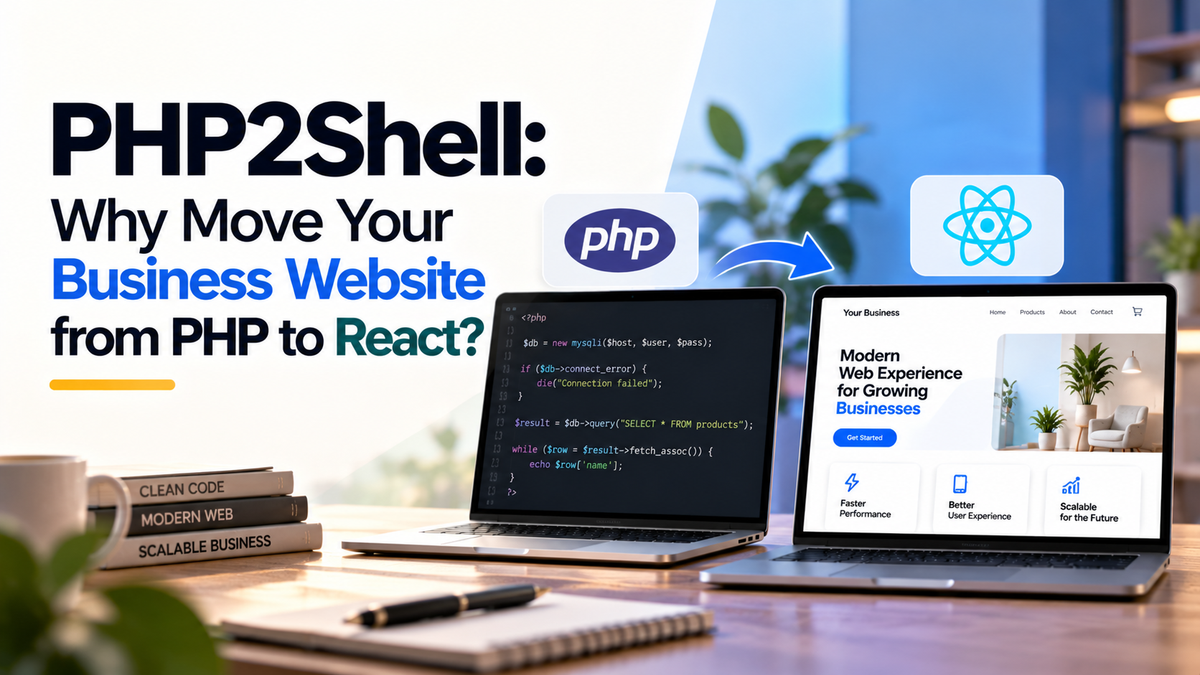
Your website may be where a customer checks your prices, books a service or decides whether to trust your business. When its underlying software needs an emergency security update, the practical question is who will fix it and how quickly.
The PHP2Shell alerts are a reason to review that responsibility. For a business already struggling with an outdated website, they can also be the moment to plan a move to a React-based architecture.
Our recommendation: patch an affected PHP installation immediately, then evaluate migration against your business needs. A React frontend alone does not remove a vulnerable PHP backend.
What happened in the October 2026 PHP security crisis?
On 21 October, PHP released fixes for two critical vulnerabilities, CVE-2026-109618 and CVE-2026-109619, which can allow remote code execution without authentication. In plain language, a successful attack could let someone run code on the server without logging in. India's CERT-In issued a critical advisory and reported exploitation in the wild. CERT-In advisory.
PHP's announcement covers installations serving web requests, including PHP-FPM and Apache mod_php. It identifies mod_php as particularly exposed. The emergency fixed releases are PHP 8.5.12, 8.4.27, 8.3.36 and 8.2.35; hosting vendors may supply backported packages. PHP security announcement.
There is also a 23 October follow-up: PHP recommends disabling session upload progress until the next regular bugfix release to protect against an additional, unusual configuration-dependent RCE path. Ask your host to review that guidance as well as the emergency patches. This does not mean every patched installation is exploitable through that path. PHP follow-up guidance.
What should a business owner do today?
Ask your hosting provider or maintenance developer to confirm the PHP runtime actually serving the website, the installed vendor security fix and whether all affected workers have been restarted. Updating WordPress or a plugin alone does not establish that the hosting runtime was patched.
If you cannot patch promptly, ask your provider about restricting or temporarily taking the affected service offline. The UK's NCSC recommends immediate action; temporary measures should not be treated as a replacement for the vendor update. NCSC guidance.
Retain logs and investigate suspicious activity. Patching closes a vulnerability; it does not establish that an earlier compromise has been cleaned up. Do not postpone this work while arranging a redesign.
What switching from PHP to React actually means
PHP is a server-side language. React is a library for building interfaces from components. They can be used together, so a new React design may still depend on the same PHP services underneath. React documentation.
A migration therefore needs an architecture decision:
- React with a maintained PHP backend: improve the interface while keeping useful business logic. PHP still needs patching and monitoring.
- React with a replacement backend: move server responsibilities into a deliberately chosen, supported stack. This removes PHP exposure only where PHP is actually retired.
- Prebuilt public pages with separate services: serve suitable brochure or catalogue pages as static files, with forms, bookings or commerce handled by maintained services. Those services still need security controls.
React's documentation supports both framework-based sites and gradual adoption within existing projects. A whole-site rewrite is one option, not a requirement. Framework options, incremental adoption.
Four reasons to consider a React migration
1. Your website needs a better customer journey
A salon might need a booking flow that explains availability and services clearly. A retailer might need product filtering and a structured enquiry basket. A service company might need a quotation journey with different questions for different jobs.
React can be a useful foundation for these interactive interfaces. The business case is a journey customers can complete and staff can manage. Measure that through successful bookings, delivered enquiries and fewer avoidable steps.
2. Every change has become a risky patch
If changing one page breaks another, or nobody can confidently explain the code, a controlled rebuild may be more useful than extending the existing structure again.
A React project can organize repeated interface elements into reusable components. Pair that with a clear content model, reviewable releases and meaningful tests. Components alone do not make a system maintainable; ownership and release discipline matter just as much.
3. A simpler public site can reduce runtime exposure
For a business that mainly publishes services, prices and a catalogue, ask whether every page needs a dynamic application server. Prebuilt pages served through a CDN can remove the need for a public PHP runtime on those routes, if the old runtime is genuinely decommissioned.
This is an architectural benefit, not an automatic React security feature. A browser-only React shell still needs any connected APIs secured. A server-rendered React application has its own server dependencies and update responsibilities. Choose the smallest operational surface that serves the business.
4. You need clearer separation between content and operations
A shop owner should be able to update opening hours or product descriptions without risking order processing. A CMS-backed React site can separate editorial work from application releases and connect the interface to business services through defined boundaries.
That separation also creates work: permissions, API validation, credentials, backups and monitoring need deliberate owners. Include these responsibilities in the project scope rather than treating launch day as the end of maintenance.
Does React make a website secure, faster or better for SEO?
None of those outcomes is automatic. React's own team disclosed a critical remote code execution vulnerability in certain React Server Components packages in December 2025. Affected server implementations required updates. That incident is a useful reminder to maintain the replacement stack too. React security advisory.
Performance depends on rendering choices, JavaScript, images and the work a visitor's device must do. A heavy React build can be slow. For public business pages, choose an appropriate static or server-rendered approach and test it on a modest phone and mobile connection.
For search, preserve useful content, crawlable links, metadata and correct status codes. A change of framework is not a ranking improvement by itself. If URLs change, prepare a page-by-page mapping and appropriate permanent redirects, then monitor the move. Google's migration guidance.
When keeping PHP is the better decision
A supported, patched PHP website with a dependable maintainer may already meet your needs. A healthy WordPress store or Laravel application does not become obsolete because a vulnerability was disclosed.
Keep and improve it when the main problems can be solved through maintenance, hosting, content or a focused interface update. Consider migration when the business also needs substantial workflow changes, the existing code is costly to maintain, or a simpler architecture would remove unnecessary dependencies.
For Indian small businesses, compare the full cost in rupees: development, content editing, hosting, subscriptions, integrations, migration and ongoing care. A low initial quote can hide a costly maintenance model in either stack.
How to migrate without losing enquiries or search visibility
Start with a patched existing site. Inventory its pages, forms, catalogue, integrations and customer data. Decide what stays, what changes and who maintains each part.
Build and test the replacement away from production. Check real enquiry delivery, bookings, payments where applicable, mobile usability and accessibility. Preserve existing URLs where sensible; map changed ones instead of redirecting everything to the homepage.
Launch with a tested backup and rollback plan. Monitor errors and business transactions, then retire the old origin and unused credentials when dependencies have been checked. Leaving the old PHP application publicly reachable can leave the original exposure in place.
Questions business owners are asking
Can React protect my existing PHP website from PHP2Shell?
Adding React does not patch PHP. If a vulnerable PHP backend remains reachable, it still needs the appropriate vendor update and operational review.
Do I need to replace WordPress immediately?
The urgent task is to address affected PHP installations. Replacement is a separate decision based on the website's condition, business requirements and maintenance cost.
Will a React rebuild guarantee more customers?
No. Judge a rebuild by usable customer journeys, reliable enquiry delivery, measured performance and maintainability. React is a tool for delivering those outcomes.
Plan your next website with Klyroo
If your current website needs repeated workarounds, use this moment to review its architecture and ownership. Klyroo can help assess the existing site and scope a React-based rebuild where it fits your requirements.
Explore Klyroo's web development services or discuss your website. Start with the platform you have, the problems you need solved and a clear plan for ongoing care.
Security information checked on 23 October 2026. Advisories can change; consult the linked vendor and CERT guidance for current remediation.